
The Seleucid gear refers to the weapons, armor, and military equipment used by the armies of the Seleucid Empire. This empire was one of the largest Hellenistic kingdoms that emerged after the death of Alexander the Great. The Seleucid military combined Greek, Macedonian, and Eastern military traditions, which made their equipment and fighting style unique in the ancient world.
Understanding Seleucid gear helps historians and enthusiasts learn how this powerful empire maintained control over vast territories stretching from the Mediterranean to parts of Asia. Their soldiers used a combination of heavy armor, specialized weapons, and strategic formations to dominate the battlefield.
In this article, we will explore the history of Seleucid gear, the types of weapons used, armor design, and the influence of different cultures on their military equipment.
The Origin and Development of Seleucid Gear
The development of Seleucid gear began after Alexander the Great’s empire was divided among his generals. Seleucus I Nicator founded the Seleucid Empire in the late 4th century BCE. Because the empire covered large regions with diverse cultures, the military adopted equipment from different traditions.
At its core, Seleucid gear was heavily influenced by the Macedonian military system used by Alexander the Great. The famous Macedonian phalanx formation remained a central part of their army. However, as the empire expanded into regions like Persia, Mesopotamia, and Syria, the Seleucid army incorporated local military equipment and techniques.
This blending of cultures created a unique military system where Greek-style armor and weapons were combined with Eastern cavalry equipment. As a result, Seleucid soldiers were equipped to fight in various terrains and against different enemies.
Weapons Used in Seleucid Gear
One of the most important components of Seleucid gear was the variety of weapons used by their soldiers. The army included infantry, cavalry, and specialized troops, each carrying different weapons suited to their role.
The most famous weapon in Seleucid gear was the sarissa, a long pike used by phalanx infantry. This weapon could reach up to six meters in length and allowed soldiers to keep enemies at a distance during battle. When used in formation, the sarissa created a powerful defensive wall of spear points.
Infantry soldiers also carried short swords known as xiphos or kopis, which were used in close combat. These swords were effective when battles moved from long-range spear fighting to hand-to-hand combat.
Other weapons included javelins, bows, and slings, particularly used by light infantry units. These ranged weapons allowed Seleucid soldiers to weaken enemy formations before direct engagement.
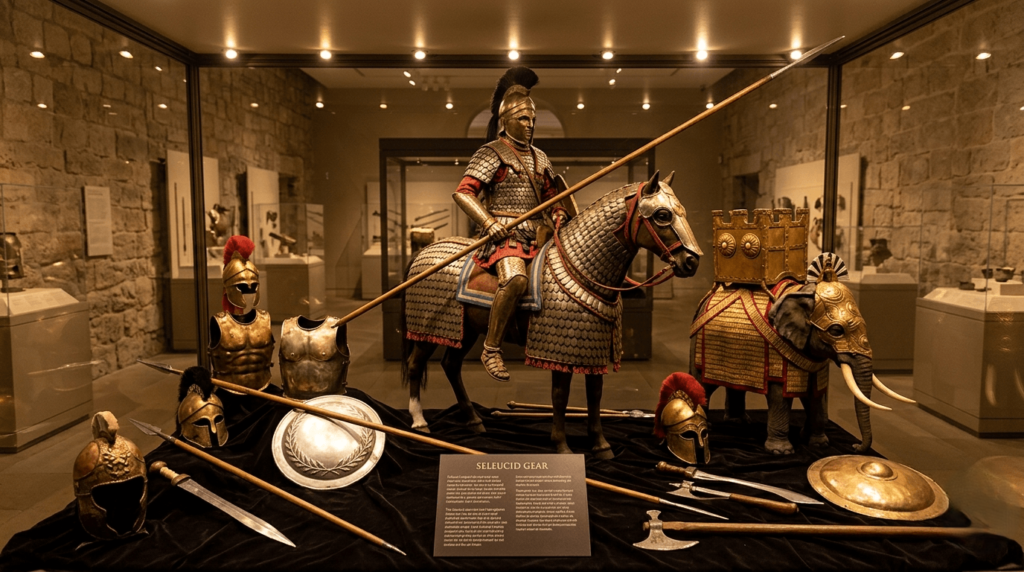
Armor and Protective Equipment in Seleucid Gear
Armor was another key aspect of Seleucid gear, designed to protect soldiers while allowing mobility in battle. The armor used by Seleucid troops was mainly derived from Greek and Macedonian designs but adapted to suit different military units.
One of the most common types of armor was the linothorax, which was made from layers of linen glued together to create a strong yet flexible protective vest. This armor was lighter than bronze armor and allowed soldiers to move more freely on the battlefield.
Some elite troops in the Seleucid army wore bronze cuirasses, which provided stronger protection against weapons. Helmets were also an essential part of Seleucid gear, often designed with cheek guards and crests to protect the head and face.
Soldiers also carried large shields, commonly known as aspis or thyreos, depending on the unit. These shields helped protect soldiers during formation fighting and close combat.
The Role of the Phalanx in Seleucid Military Gear
The phalanx formation was the backbone of the Seleucid army, and much of Seleucid gear was designed specifically to support this formation. The phalanx consisted of heavily armed infantry soldiers standing in tightly packed rows, each holding a sarissa spear.
Because the spears were so long, several rows of spear points could extend beyond the front line, making it extremely difficult for enemies to approach. This formation required disciplined soldiers and specialized equipment.
The Seleucid gear used by phalanx soldiers included long spears, helmets, shields, and body armor. These soldiers were trained to move together as a unit, creating a defensive wall that was very effective against enemy infantry.
However, the phalanx had weaknesses, especially when attacked from the sides or rear. To compensate for this, the Seleucid army relied on cavalry and light infantry support.
Cavalry Equipment in Seleucid Gear
Cavalry units played a crucial role in Seleucid military strategy, and their equipment formed an important part of Seleucid gear. The empire was known for its powerful cavalry forces, which were influenced by Persian and Central Asian traditions.
One of the most famous cavalry units was the Companion-style cavalry, inspired by the elite cavalry of Alexander the Great. These riders were heavily armed and used long lances to charge enemy lines.
Another important unit was the cataphract cavalry, which featured heavily armored riders and horses. This type of Seleucid gear offered exceptional protection, allowing cavalry to break through enemy formations.
Cavalry soldiers often carried long spears, swords, and sometimes bows, making them versatile fighters who could adapt to different combat situations.
Cultural Influences on Seleucid Gear
Because the Seleucid Empire controlled many regions across the Middle East and Asia, its military equipment reflected a mix of cultural influences. Seleucid gear combined elements from Greek, Persian, Anatolian, and Central Asian traditions.
For example, Greek-style armor and shields were used by many infantry units, while Persian-style cavalry equipment influenced the design of horse armor and mounted weapons.
This cultural blending allowed the Seleucid army to adapt its gear and tactics depending on the region and enemy they faced. It also helped the empire recruit soldiers from different ethnic groups, each bringing their own military traditions.
The diversity of Seleucid gear made the army flexible and capable of fighting in many types of warfare.
The Importance of Seleucid Gear in Ancient Warfare
The effectiveness of the Seleucid army depended greatly on the quality and design of Seleucid gear. Properly equipped soldiers could maintain strong defensive formations, conduct powerful cavalry charges, and use ranged weapons to control the battlefield.
The combination of heavy infantry, cavalry, and specialized troops allowed the Seleucid military to compete with other powerful states of the ancient world, including the Ptolemaic Kingdom and the Roman Republic.
Military equipment played a key role in maintaining the empire’s strength for several centuries. Although the Seleucid Empire eventually declined, its military system and gear design influenced later armies in the region.
Modern Interest in Seleucid Gear
Today, historians, archaeologists, and historical reenactors are fascinated by Seleucid gear. Many researchers study ancient artifacts, sculptures, and historical texts to understand how these soldiers were equipped.
Museums often display replicas of Seleucid weapons and armor, allowing visitors to see how ancient armies prepared for battle. Reenactment groups also recreate Seleucid gear to demonstrate historical warfare techniques.
This ongoing interest helps preserve knowledge about the military traditions of the Seleucid Empire and their impact on ancient history.
Conclusion
The study of Seleucid gear reveals how the Seleucid Empire built a powerful and adaptable military system. By combining Greek military traditions with Eastern influences, the Seleucid army developed unique weapons, armor, and tactics.
From the long sarissa spears of the phalanx to the heavily armored cataphract cavalry, Seleucid gear played a major role in shaping the empire’s military strength. These tools allowed the Seleucid army to defend vast territories and compete with rival powers.
Today, the legacy of Seleucid gear continues to attract historians and enthusiasts who want to understand the strategies and equipment that defined one of the most influential empires of the Hellenistic world.