Lemon Law Attorney Alabama
Buying a new vehicle usually comes with an expectation that the car, truck or SUV will operate safely and reliably. Some buyers instead find themselves returning to the dealership several times for the same serious problem. Mechanical failures, electrical faults, steering issues, braking problems and other defects can make a recently purchased vehicle frustrating or unsafe to use.
Alabama has a Motor Vehicle Lemon Law that provides certain protections for qualifying consumers and vehicles. A Lemon Law attorney in Alabama can review repair records, warranty documents and communication with the manufacturer to determine whether a consumer may have a valid claim.
Not every defective vehicle qualifies. The age of the vehicle, mileage, warranty coverage, type of defect and repair history can all affect the case.
How Alabama Lemon Law Works
Vehicles Covered by Alabama Lemon Law
Alabama law defines a consumer in this context as someone who purchases a new or previously untitled motor vehicle primarily for personal, family or household use, along with certain other people entitled to enforce the warranty.
The statute generally applies to qualifying self propelled vehicles intended primarily for public highway use. Motor homes and vehicles with a manufacturer gross vehicle weight rating of 10,000 pounds or more are excluded from the statutory definition of motor vehicle.
The Alabama Attorney General has stated that the state’s Lemon Law applies to new vehicles rather than ordinary used vehicle purchases.
What Is a Nonconforming Condition?
A minor inconvenience does not automatically make a vehicle a lemon.
Alabama law describes a nonconforming condition as one that violates the manufacturer’s express warranty and significantly impairs the vehicle’s use, value or safety.
The problem must arise through ordinary use. Problems caused by abuse, neglect, unauthorized modification, alteration, an accident or subsequent vehicle damage may fall outside this definition.
This distinction can become very important in a disputed claim. Manufacturers may argue that a particular problem resulted from something outside the original vehicle or warranty.
Alabama Lemon Law Rights Period
The First Year or 12,000 Miles
Timing is a major part of an Alabama Lemon Law claim.
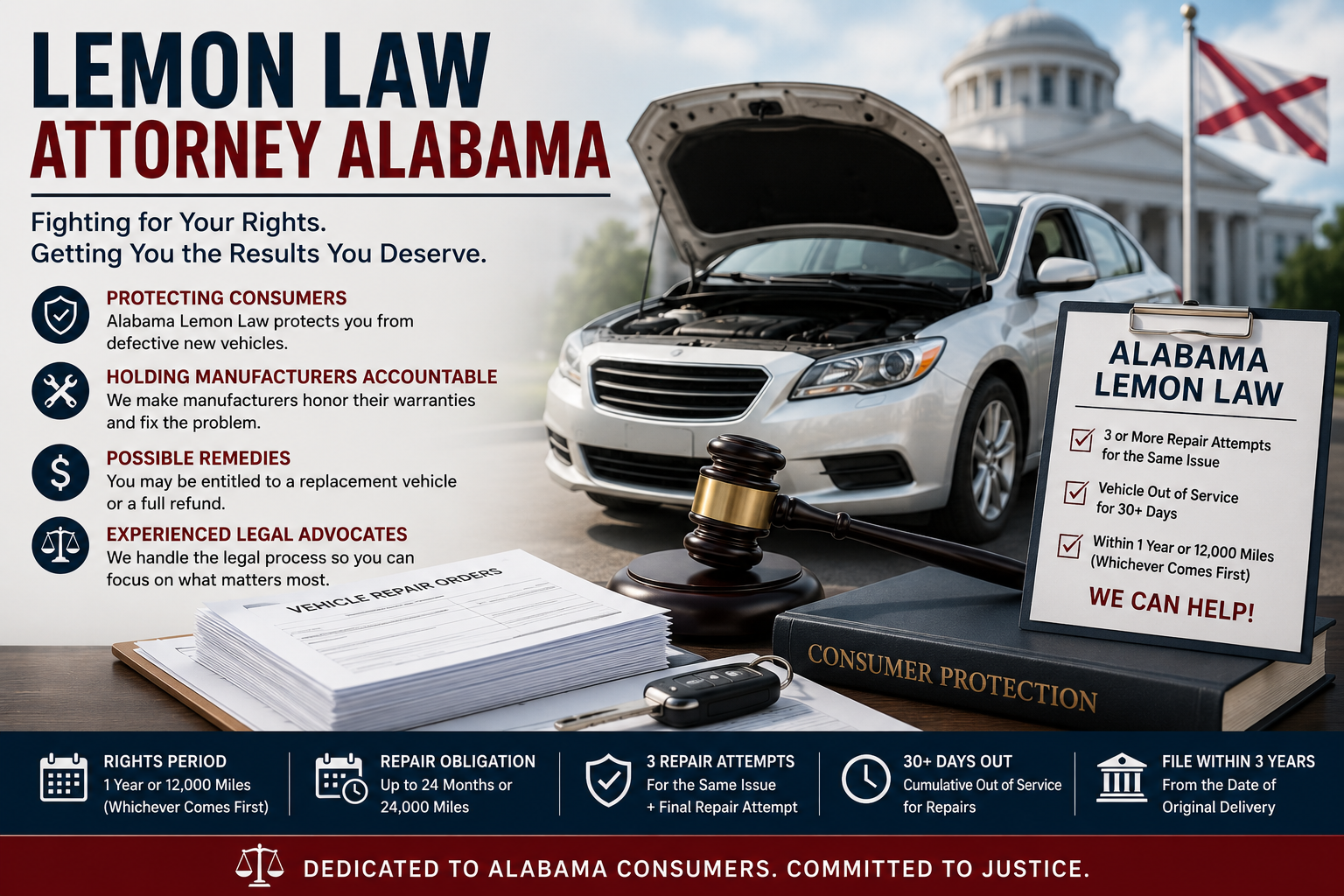
The statutory Lemon Law rights period ends one year after original delivery of the vehicle or after the first 12,000 miles of operation, whichever occurs first.
A consumer who notices a serious defect should not just keep driving and hope it eventually disappears. Repair visits and written records from this early period can become important evidence later.
Repair Obligations Can Continue
A timely reported defect does not necessarily lose protection simply because repairs continue after the initial rights period.
Under Alabama law, the manufacturer’s repair obligation for a condition first reported during the Lemon Law rights period can continue up to 24 months after delivery or 24,000 miles, whichever happens first.
This is one reason accurate dates and mileage records matters so much.
How Many Repair Attempts Are Required?
Repeated Attempts for the Same Problem
Alabama law provides a presumption concerning reasonable repair attempts in certain circumstances.
One situation involves the same nonconforming condition being subjected to three or more repair attempts by the manufacturer, its agents or authorized dealers, with at least one attempt occurring during the Lemon Law rights period, followed by a final repair opportunity for the manufacturer, and the problem still exists.
A vehicle owner should retain every repair order, including visits where a dealer says it could not reproduce the reported problem.
30 Days Out of Service
Another statutory situation concerns a vehicle that remains out of service in the custody of the manufacturer, its agent or an authorized dealer for repair attempts for a cumulative total of 30 calendar days within the applicable 24 month or 24,000 mile period.
There are statutory exceptions for repair delays caused by circumstances beyond the control of the manufacturer or authorized repair parties.
The days do not necessarily have to come from one continuous dealership visit. Keeping a timeline of every repair visit can make the history easier to review.
Why Written Records Matter
A Lemon Law claim can become difficult when a consumer remembers numerous repair visits but has very little documentation.
Keep copies of:
Purchase documents
Manufacturer warranty
Every repair order
Service invoices
Vehicle mileage at each visit
Dates the vehicle entered and left the dealership
Emails and letters with the dealer or manufacturer
Written notices sent to the manufacturer
Photos or videos showing recurring problems when relevant
Check repair orders before leaving the dealership. The description should accurately reflect the complaint you reported.
If you report that the vehicle loses electrical power during driving but the paperwork simply says “customer requested inspection,” that vague description may not properly show the history of the defect.
What Can a Lemon Law Attorney in Alabama Do?
Review Whether the Vehicle Qualifies
A Lemon Law attorney can compare the facts of a particular vehicle problem with Alabama’s statutory requirements.
The attorney may examine when the vehicle was purchased, when the defect first appeared, mileage at the first repair visit, how many repairs occurred and how long the vehicle remained unavailable.
This review can help identify weaknesses before a consumer begins a formal claim.
Communicate With the Manufacturer
Vehicle disputes can involve dealership service departments, manufacturer representatives, warranty administrators and corporate customer service teams.
An attorney can handle legal communication and organize the documents supporting a claim. This may be especially useful where the manufacturer disputes whether a problem is covered by its express warranty.
Evaluate Available Remedies
When statutory requirements are satisfied, the manufacturer may have obligations beyond repeatedly attempting another ordinary repair.
The exact remedy depends on the facts and applicable law. Alabama law addresses replacement or refund remedies in qualifying circumstances and permits a reasonable allowance related to the consumer’s use of the vehicle.
A lawyer can calculate and explain how those provisions may apply to a particular case rather than promising a specific result before reviewing the evidence.
Does Alabama Lemon Law Cover Used Cars?
Consumers need to be careful here.
The Alabama Attorney General has expressly advised consumers that Alabama Lemon Law protection applies to new vehicles and does not provide ordinary Lemon Law coverage for used automobiles.
That does not automatically mean someone with a defective used vehicle has no possible legal rights. A separate written warranty, service contract, financing issue, misrepresentation or another consumer protection law might present a different question.
Those issues are separate from saying that a used vehicle qualifies under Alabama’s Motor Vehicle Lemon Law.
Is the Dealer Responsible?
A recurring defect often sends an angry vehicle owner back to the dealership, yet Alabama’s statutory Lemon Law primarily places the relevant obligations on the manufacturer.
This distinction matters. The dealer performing warranty repairs may not necessarily be the party legally responsible for the Lemon Law remedy.
An attorney can identify the appropriate parties before a consumer spends time pursuing a claim against the wrong business.
Deadline for Filing an Alabama Lemon Law Action
Consumers should pay close attention to deadlines.
Alabama Code Section 8 20A 6 states that an action under the Motor Vehicle Lemon Law against the manufacturer must be commenced within three years following the date the vehicle was originally delivered to the consumer.
Waiting can create evidence problems too. Documents disappear, memories become less reliable and repair histories get harder to organize.
Someone considering legal action should get individual legal advice about the deadline applicable to their situation rather than assuming there is still plenty of time.
Choosing an Alabama Lemon Law Attorney
Look for an attorney who handles consumer vehicle disputes and is familiar with Alabama’s Motor Vehicle Lemon Law.
During an initial discussion, ask what documents the attorney needs and how the claim process works. Bring the complete repair history rather than just the latest invoice.
A useful case review normally begins with facts: purchase date, mileage, warranty, reported defects, repair attempts and days the vehicle was unavailable.
No attorney can responsibly guarantee that every defective new car will qualify as a lemon. The statutory requirements and evidence need to be reviewed first.
Frequently Asked Questions
How many repair attempts can qualify under Alabama Lemon Law?
Alabama law provides a presumption in certain cases where the same nonconforming condition has undergone three or more repair attempts, at least one during the Lemon Law rights period, plus a final manufacturer repair attempt and the condition continues.
What is the Alabama Lemon Law rights period?
It generally ends one year after original vehicle delivery or at the first 12,000 miles of operation, whichever happens first.
Does Alabama Lemon Law cover used vehicles?
The Alabama Attorney General states that Alabama’s Lemon Law applies to new vehicles and does not provide Lemon Law protection for ordinary used automobiles.
Does being without my vehicle for 30 days matter?
Yes. Alabama law contains a separate presumption involving a qualifying vehicle being out of service for repair attempts for a cumulative total of 30 calendar days during the applicable statutory period, subject to certain exceptions.
How long do I have to file a Lemon Law lawsuit in Alabama?
An action under Alabama’s Motor Vehicle Lemon Law against the manufacturer must be commenced within three years after the vehicle’s original delivery to the consumer.
Should I speak with an Alabama Lemon Law attorney?
Legal counsel can be useful when a new vehicle has a serious recurring warranty defect, has undergone repeated repairs or has spent considerable time out of service. An attorney can review the particular facts and explain which laws and remedies may apply.
This article provides general information and is not legal advice. Individual cases can involve different facts, warranties, deadlines and legal issues.