Cross Drawing: A Practical Guide From Sketch to Print
Football Drawing Guide for Artists, Students and Print Creators
Arslan Khokhar
September 16, 2026
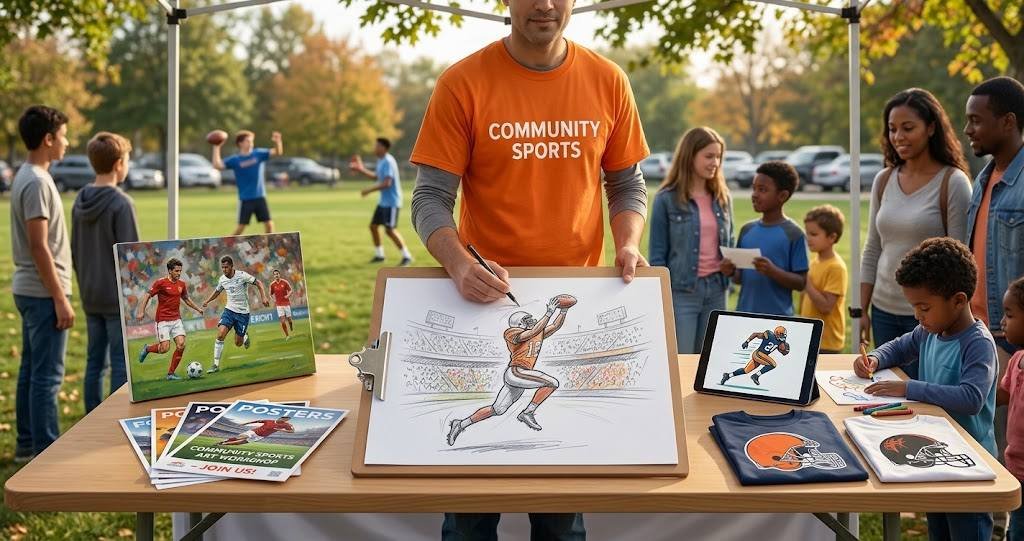
Football drawing brings sports action onto paper, canvas, tablets, posters, shirts and classroom projects. An artist may draw an American football with leather texture, a quarterback preparing a pass, or a full stadium scene. Soccer art can fit the same broad phrase, yet this guide focuses mainly on American football and explains where soccer drawing methods differ.
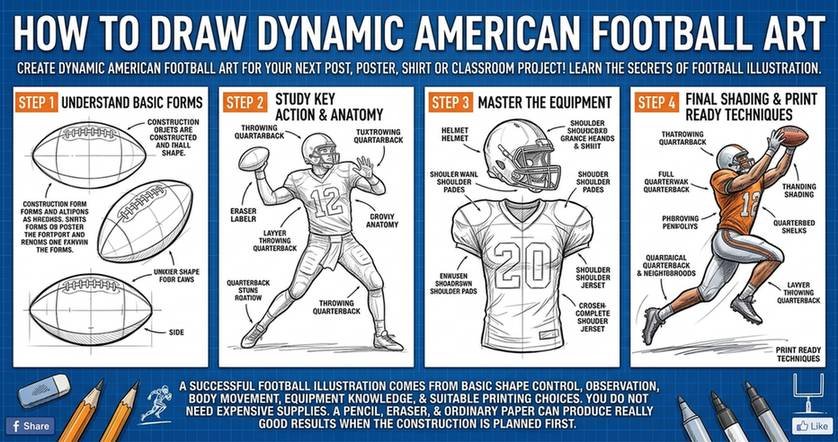
A successful football illustration comes from basic shape control, observation, body movement, equipment knowledge and suitable printing choices. You do not need expensive supplies. A pencil, eraser and ordinary paper can produce really good results when the construction is planned first.
What Is a Football Drawing
A football drawing is an image that represents the ball, players, uniforms, fields or action connected with football. It may be realistic, cartoon based, technical, decorative, or made for commercial printing.
Beginners often start with the ball since it has one main form. Player drawings are more difficult. A player have a moving body, protective equipment, fabric folds and strong changes in perspective. Those parts become manageable after the figure is divided into circles, cylinders and simple body masses.
Football drawings appear in many industries and settings.
- Sports publishing and editorial illustration
- NFL and NCAA fan artwork
- School posters and activity sheets
- Apparel printing for shirts and hoodies
- Team branding and social media graphics
- Trading cards, stickers and wall prints
- Coaching diagrams and playbooks
- Video games and sports animation
Major sports entities such as the NFL, NCAA, FIFA and Major League Soccer influence uniform styles, field markings and visual trends. Equipment companies such as Wilson, Nike and Riddell give artists useful references for footballs, cleats, helmets and pads. Their trademarks should not be copied for commercial use without permission.
Materials for Football Drawings
Traditional Drawing Supplies
A standard graphite pencil set gives an artist several value choices. An HB pencil works for the first sketch. Softer pencils such as 2B, 4B and 6B create dark shadows. A kneaded eraser can lift graphite from curved highlights without damaging paper.
Smooth Bristol paper suits ink drawings and marker work. Textured drawing paper produces grainy shading that can make leather, grass and uniform fabric feel more natural. Colored pencils are affordable and easy for younger artists, but alcohol markers can produce bolder team colors.
Digital Drawing Tools
Adobe Photoshop and Adobe Illustrator are common in professional design and printing. Photoshop is suited to painted shading and textured illustrations. Illustrator creates vector artwork that can be resized for a small sticker or a large stadium banner.
Procreate is popular among iPad artists. Clip Studio Paint supports comic lines and action poses. A pressure sensitive stylus helps line weight change as your hand moves, which make the image look more active.
Canvas size matters in digital work. For printing, create artwork at 300 pixels per inch. Posters may use CMYK color, yet online graphics usually use RGB. Ask the print provider for its preferred file type before finishing the artwork.
A Football Drawing Step by Step
Drawing the Main Shape
Begin with a long oval. Make both ends slightly pointed, but avoid making them needle sharp. An American football has rounded tips and a wide middle. Draw a curved line near each end to show the seams where the leather panels meet.
Add a center seam along the upper middle area. Place short lace lines across it. These line helps identify the object at once. Keep the laces centered and let them follow the curved surface rather than sitting flat.
Building Form With Light and Shadow
Choose a light source before shading. If light comes from the upper left, the lower right section should become darker. Add a narrow reflected light near the shaded edge so the ball does not look flat.
Use curved shading strokes that follow the football form. Small dots and irregular marks suggest pebbled leather. Do not cover the whole ball with identical marks since actual texture changes with lighting and distance.
A cast shadow grounds the football. Draw a soft oval beneath it and make the darkest area close to the ball. This simple shadow can turn a basic classroom sketch into an image that feels three dimensional.
Adding Color and Surface Detail
Football leather is often brown, yet color varies by league, age and product. Use warm brown in the middle, darker brown near the edges and a pale highlight across the lit area. White stripes may appear on college or youth footballs.
Study a Wilson football or another real reference to see panel placement. Reference study is research, not tracing. Commercial artwork should avoid protected logos when a license is not available.
How to Draw Football Players Step by Step
Start With the Action Line
Draw one loose line from the head through the spine and supporting leg. This action line records the direction of movement. A runner leans forward, a quarterback rotates through the torso and a receiver may stretch upward with one arm.
The pose should be readable before pads or clothing are added. If the stick figure looks stiff, extra detail will not fix it.
Construct the Body
Place an oval for the head and a block for the rib cage. Add a smaller form for the pelvis. Connect shoulders, elbows, hands, knees and feet with simple lines. Use cylinders around the limbs after the pose feels balanced.
Football pads make the shoulders wider than a normal human outline. The waist remains narrower, so the upper body may resemble a broad triangle. Keep the hips and knees flexible. Many beginner drawings works poorly because both legs receive the same angle.
Add Helmet and Protective Equipment
Draw the helmet as a rounded shell around the skull rather than a circle placed on top of it. Leave space in front of the face for the mask. The face mask can be simplified into two or three curved bars for a small image.
Add shoulder pads, jersey sleeves, gloves, pants, knee pads and cleats. Protective equipment are bulky, but the body must still feel present below it. Watch where fabric stretches across the thigh and where it gathers near the waist.
Riddell helmet references and Nike uniform photography can help an artist study current equipment. Use them to learn structure and materials, not to reproduce branding without approval.
Draw Hands and the Football
Hands often decide whether the pose feels believable. A quarterback grips the rear half of the football with fingers spread. A runner presses the ball against the forearm, ribs and upper arm. A receiver watches the ball and opens both hands before contact.
Draw mitten shapes first. Separate the fingers after position and scale look correct. This saves time and prevents tiny details from controlling the larger pose.
Finish the Uniform and Shadows
Place jersey numbers across the chest or back. Let each number follow the curve of the torso. Flat numbers can make a rounded body look like cardboard.
Dark areas often appear beneath the helmet, under the shoulder pads, between the legs and below the arms. Keep the face readable through selective light. Deep shadow around the eyes may create intensity, though too much can erase the player expression.
How to Draw a Football Player Step by Step for Beginners
A beginner can use this shorter method for a simple standing player.
- Draw a circle for the head.
- Add a wide shoulder shape and a narrow waist.
- Place straight guide lines for arms and legs.
- Build cylinders around the guides.
- Draw the helmet outside the head circle.
- Add a face mask and a small section of the face.
- Place a football under one arm.
- Add jersey, pants, socks and cleats.
- Erase construction lines.
- Add team colors, grass and a soft ground shadow.
Keep the first version simple. One can add a stadium crowd later, but the player silhouette deserves attention first. It is very normal for the first pose to feel a little wooden. Draw it again with bent knees and uneven shoulder heights, and it usually gets more believable.
Drawing Football Action Scenes
Running and Tackling Poses
Action scenes need weight and direction. In a running pose, place the chest slightly ahead of the hips. Bend the rear leg and open the front knee. Arms move opposite the legs during a natural sprint.
For a tackle, show contact through overlapping forms. One figure may lean into another at the hips or torso. Avoid excessive injury detail for school materials or younger audiences.
Passing and Catching Poses
A passing pose uses torso rotation. The throwing shoulder moves back before release, then the arm comes forward. The opposite foot often leads. A catching pose needs a clear visual path between the ball and the hands.
Motion lines may be used in cartoons. Realistic work usually relies on body angle, flying grass and fabric movement. Too many speed marks can make an image busy.
Field and Stadium Backgrounds
Use perspective lines for yard markers and sidelines. Figures farther away should become smaller and carry less detail. Stadium seating can be suggested with grouped value shapes rather than hundreds of individual people.
A soccer football drawing follows related ideas. Start with a circle, map curved polygon panels and add soft shading. FIFA match photography offers useful references for kicking, dribbling and goalkeeping poses.
Football Drawings for Printing
Preparing the Artwork
Printed art depends on resolution, color and final size. Raster art should normally be prepared at 300 pixels per inch at the intended print dimensions. Vector files from Adobe Illustrator can scale without losing edge quality.
Convert fonts to outlines when a print shop requests it. Keep a separate editable file before conversion. Add bleed when color reaches the paper edge. Many printers request one eighth inch bleed, but their requirement can be different.
Pantone spot colors help keep team colors consistent across print runs. CMYK values may change slightly between coated paper, uncoated paper and fabric. Epson and Canon photo printers can produce rich home prints, though monitor calibration and paper profile still affect color.
Choosing a Printing Method
Screen printing works well for bold shirt graphics with limited colors. Direct to garment printing suits detailed illustrations and smaller orders. Dye sublimation is often used for polyester sportswear. Giclée printing is a good choice for art prints made with archival pigment ink.
Before a large order, request one proof. Check small jersey numbers, face mask lines, dark shadows and skin tones. A line that looks thick on a tablet may print much thinner than expected.
Artificial Intelligence in Football Drawing and Scientific Research
Artificial Intelligence now supports pose research, image classification and drawing assistance. Computer vision systems can examine game footage and estimate joint locations. OpenPose and related pose estimation research gives artists a way to study body movement frame by frame.
Generative image systems can produce rough pose concepts, color ideas or background options. Their results is not always anatomically reliable. Hands, helmet bars, jersey numbers and ball direction may appear incorrect, so an artist still needs observation and editing skill.
Scientific researchers use machine learning to analyze athlete motion, injury patterns and visual perception. Similar data can guide illustrators who want more believable running, throwing or tackling positions. Motion capture used by sports scientists and game studios records joint rotation that a static photo can hide.
Copyright, consent and data bias matter here. An AI generated image may resemble an athlete, logo or photographer’s composition. Commercial creators should check usage rights and should not present generated material as direct scientific evidence. AI can assist a drawing process, but judgment stays with the artist.
Common Football Drawing Mistakes
- Making the football too round
- Drawing both body sides in the same pose
- Placing shoulder pads above the actual shoulders
- Forgetting that jersey numbers curve with the body
- Using black for every shadow
- Adding details before the pose is checked
- Printing low resolution artwork at a large size
- Copying team logos without considering licensing
These problems are very common, and fixing the basic silhouette usually gives more improvement than adding extra texture. The same benefit can be said another way: better structure makes better detail, and better structure really makes the finished print stronger too.
Questions and Answers
What is the easiest football drawing for a beginner
A single football is the easiest subject. Start with a pointed oval, add panel seams and laces, then shade one side.
How do you draw a football player step by step
Begin with an action line and stick figure. Build the torso, pelvis and limbs with simple forms. Add pads, helmet, uniform, hands and shadows after the pose works.
How can football drawings look realistic
Use photo references, accurate body balance, curved shading and varied edges. Study real equipment and place shadows according to one light source.
Can football drawings be printed on shirts
Yes. Screen printing, direct to garment printing and dye sublimation are common choices. The best method depends on fabric, order size and color count.
Can AI create a football drawing
AI can generate concepts and pose references. The artist need to check anatomy, equipment, trademarks and image rights before using the result.
What file type is best for printing
PDF, TIFF and high resolution PNG files are widely accepted. AI, EPS and SVG files suit vector art. Always ask the selected printer which format and color profile they accept.
Football drawing becomes easier through repeated observation and simple construction. Start with large shapes, check the movement, then place equipment and surface detail. Whether the final image is meant for a sketchbook, science project, poster or printed shirt, solid drawing structure gives it a stronger and more convincing finish.
Share It
Previous Post
Next Post
Recent Posts