Paxiart

Quadcopter Drone: Complete Guide, Types, Uses, and Buying Tips

quadcopter drone

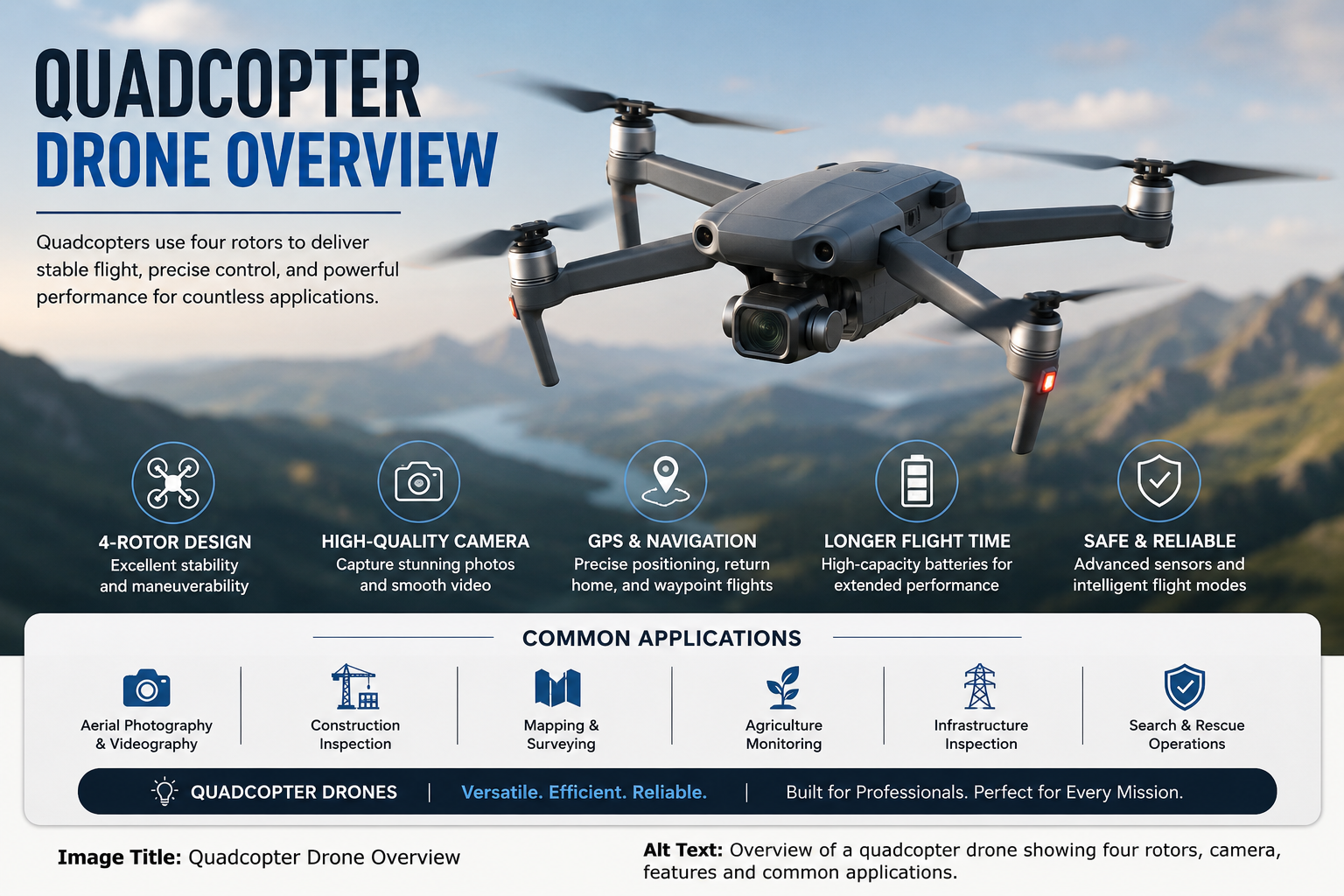
A quadcopter drone is a small, smart flying machine that’s easy to control and fun to use. This quadrotor drone has four propellers that let it hover, tilt, and move in any direction, even straight up and down. Modern quadcopter UAVs stay steady with smart sensors, making the quadcopter aircraft perfect for photos, mapping, inspections, farming, or research.

What Is a Quadcopter Drone?

A quadcopter is a flying vehicle that uses four rotors to lift itself into the air and control its flight. This drone, which people call a quadrotor, is a multirotor UAV that offers beginners control through its inherent stability. A quadcopter is a flying robot powered by four motors and propellers. Two spin clockwise, and two spin counterclockwise, keeping the drone balanced and stable. This balance lets it respond smoothly to commands and stay steady in the air.

The drone achieves automatic height control and programmed route following and task completion through its combination of sensors and GPS system and flight control system. The advanced capabilities of modern drones make them achieve intelligence through the use of artificial intelligence and machine learning algorithms. Moreover, a proper quadcopter UAV definition possesses the ability to remain suspended in the air while moving sideways and turning without needing to advance forward, which fixed-wing drones require for sustained flight. 

A quadcopter serves as an intelligent UAV that uses basic mechanical components to operate advanced control systems. The combination of these two elements makes quadcopters one of the most powerful drones available today. Their motors and controls respond instantly, making them efficient, versatile, and easy to use.

How Do Quadcopter Drones Differ from Other UAVs?

The main difference in quadcopter vs fixed wing drone is how they fly. Quadcopter drones use vertical movement to navigate through narrow spaces while fixed-wing drones operate through airplane-style gliding. In multirotor vs fixed wing comparisons quadcopters can take off and land vertically which differs from the requirement of fixed-wing drones to have either launch systems or dedicated runways.

A quick quadcopter vs UAV comparison shows quadcopters are slower but much more precise and flexible, making them ideal for tasks that need steady control. Doing a drone type comparison helps you pick the right drone for the job.

Why Are Quadcopters the Most Popular Drone Type Today?

The rise of quadcopters’ popularity is because of how accessible and reliable they have become. Even if it is compared to other UAV designs, it is still easier to control, safer to use in operations, and more adaptable to many uses, especially the real-world ones, driving a strong drone adoption globally. 

One of the many major reasons for the growth in quadcopter demand is that they are often an easy-to-fly drone option, even for beginners. Features like built-in stabilization systems and autonomous features make users focus more on the tasks instead of minding complex piloting skills. These features make quadcopters a smart and natural choice among consumers of drones, especially those who are first-time users.

Looking at it from a professional standpoint, quadcopter advantages go beyond commercial and industrial sectors. A lot of commercial drones and industrial UAVs depend on quadcopter designs since they provide a drone platform that’s stable for cameras, sensors, and payloads. 

How Does a Quadcopter Drone Fly?

The fundamental principles of drone aerodynamics and multirotor aircraft flight maintenance apply to understanding quadcopter drone flying. A quadcopter requires four motors together with propellers to create the VTOL flight power, which operates without the need of wings. 

During quadcopter flight, the drone does not glide like an airplane. The rotors generate upward lift through their downward airflow, which they create by pushing air toward the ground. This quadcopter flying mechanism operates through motor speed control, which generates both stability and motion for the quadrotor flight system. The design of quadcopters makes them suitable for multirotor flight operations that require both hovering and slow, precise movement. 

The flight controller uses sensor data to direct motor power while it manages all flight operations of the system. The real-time process functions as the fundamental requirement that enables effective drone stabilization through its operation, and through this process modern UAV flight mechanics achieve stability, which enables quadcopters to fly smoothly under difficult weather conditions.

Principles of Lift and Stability

A quadcopter rises when its rotors spin faster and sinks when they slow down. Its two propellers spin one way and the other two spin the opposite way, keeping it balanced. The rotors constantly adjust to stay steady in the air, handling wind smoothly so the drone hovers and moves predictably.

Roll, Pitch, Yaw, and Throttle Explained

To understand quadcopter roll, pitch, and yaw, it helps to think of how the drone tilts and rotates in three-dimensional space.

  1. Roll control lets the quadcopter slide left or right by lifting one side more than the other, causing a gentle sideways tilt.
  2. Pitch control moves the quadcopter forward or backward by tilting the body and pushing it in that direction while staying in the air.
  3. Yaw control turns the quadcopter left or right by adjusting opposite propeller speeds, allowing smooth rotation without leaning.
  4. Throttle control manages altitude. More power makes the quadcopter rise; less power brings it down.

Together, these four controls define every possible quadcopter movement during flight.

Flight Controller and Sensors

  • Quadcopter flight controller: Acts as the brain, reading sensor data and adjusting motor speeds to keep the drone balanced, on course, and at the right altitude.
  • Gyroscope and accelerometer: Measure rotation, tilt, and movement in real time. They help the drone correct tiny shifts instantly, forming the core of drone stabilization.
  • GPS sensor: Helps the quadcopter know its exact position and hold its place in the air.
  • Barometer: Measures air pressure to maintain steady altitude.
  • Autonomous stabilization: Lets the quadcopter hover, follow flight paths, and assist pilots during manual control, making flight smooth, precise, and easy.

What are the Types of Quadcopter Drones?

The different types of quadcopters exist in multiple quadcopter configurations and designs, which produce distinct advantages that depend on the specific quadrotor type, quadcopter frame, and complete UAV design. The different elements determine how stable the aircraft operates, how well it flies, how much weight it can carry, and how easy it is to operate.

X-Frame Quadcopter

The X-frame design represents the most frequently used configuration for quadcopters. The design creates an X shape through its four arms, which enables the system to achieve balanced performance with stable operation. This design is widely used in consumer drones and aerial photography because it offers reliable control and a solid UAV architecture.

H-Frame Quadcopter

The H-frame exists for situations that require heavy-duty professional operations. The wider frame design of the equipment creates additional storage capacity, which makes it suitable for industrial operations and inspection work and the transportation of cameras and sensors. 

Plus (+) Configuration Quadcopter

The Plus configuration has a simpler control layout, which makes it the most suitable option for beginner pilots who want to operate drones. The pilots of this aircraft can navigate their flights better because of its straightforward frame design. This drone configuration serves as the best equipment for learning fundamental multirotor flight skills.

Y4 Quadcopter

The Y4 quadcopter uses a compact layout with four propellers arranged in a stacked configuration. The design optimizes space usage while maintaining stable performance through its compact frame structure. The design of its UAV system enables operation in situations where space constraints and needs for portable solutions exist.

V-Tail and A-Tail Quadcopters

V-tail and A-tail quadcopters use special rear motor configurations that enhance their ability to fly through the air. The designs of these systems create optimal flight performance, which enables fast movement and agile turning abilities, making them different from other quadrotor systems.

Advantages of Quadcopter Drones

The unique quadcopter advantages make quadcopters the most popular multirotor UAV. Their design and functionality provide multiple applications through their ability to operate in different ways and their user-friendly control system and their dependable performance. 

The three aspects that define quadcopters’ benefits, quadcopters’ features, and quadcopters’ strengths explain the superior performance of these drones when compared to any other type of unmanned aerial vehicle. These features also show why their multirotor advantages make them stand out.

High Maneuverability

Quadcopters can take off and land anywhere, even in tight spaces. Their steady hovering and quick movements make them perfect for photography, inspection, and monitoring.

Versatility Across Industries

Quadcopters are incredibly flexible and work in almost any situation. They shine as hobby drones for fun, as commercial drones for mapping and surveying, and as industrial drones for inspection and delivery.

Cost-Effective UAV Platform

Quadcopters provide high performance with their budget-friendly pricing. The basic design of their quadcopter frame enables both lower production expenses and simpler upkeep processes, which makes the drones affordable for all users.

Easy to Fly and Learn

Quadcopters are super beginner-friendly. Their easy controls and smart automated flight help new pilots fly confidently while avoiding obstacles.

Quadcopter Drone vs. Fixed-Wing Drone

When choosing the right drone, it is important that it should relate to the mission. The decision between a quadcopter vs. a fixed-wing drone often comes down to the style of the flight, their endurance, and, of course, versatility. When talking about UAV comparison, quadcopters, fixed-wing drones, and hybrid VTOLs each have their own advantages, and a proper drone comparison can help find the best option.

The differences between multirotor vs. fixed wing are clear. Multirotor UAVs can hover, they can also take off vertically, and of course, they can navigate in spaces that are tight. On the other hand, fixed-wing UAVs efficiently glide, they also cover long distances, and of course, offer a prolonged flight time.

From its own term, hybrid VTOL drones combine each other’s elements, providing capabilities related to hovering and longer range, though with a complexity added in aerospace engineering and control systems.

When to Choose a Quadcopter Drone

  • It is best to use it for short-range missions where flexibility is key.
  • It is ideal for hovering and vertical inspections.
  • It is also perfect for tasks that need aerial precision rather than long endurance.

When to Choose a Fixed-Wing Drone

  • It is best for mapping in long-range or surveying areas that are large.
  • It is best for long operations since it offers extended flight time because of its higher efficiency and aerodynamic lift.
  • It is also an ideal drone for missions where speed, range, and endurance are more important than hovering.

Quadcopter vs. Fixed-Wing vs. Hybrid VTOL

  • Compare by flight time, payload, range, and cost.
  • Multirotor UAVs show better performance in control abilities and stable operation, and they can hover and move through various flight modes.
  • Fixed-wing UAVs show superior performance because they can sustain flight for extended periods while traveling great distances.
  • The hybrid VTOL system delivers an intermediate solution that enables vertical takeoff and provides extended flight capabilities.

Applications and Uses of Quadcopter Drones

The continuous expansion of modern quadcopter applications is unstoppable considering the fact that these drones are everywhere, proving their value across many sectors.  They exist everywhere thanks to their stability, hovering ability, and, of course, ease of control. Moreover, quadcopters remain dominant in many UAV applications as well as widely adopted throughout the drone industry. 

In any UAV or drone comparison, quadcopters stand out oftentimes for short-range and precision-based missions when compared in a quadcopter-versus-fixed-wing-drone analysis or discussion about multirotor versus fixed-wing. In terms of aerial data collection, quadcopters truly excel. They are also excellent in professional UAV missions where being accurate and in control matters more than long-distance endurance.

Personal and Recreational Use

People like to fly quadcopters during their leisure time because the drones provide a simple flying experience, and they maintain stable flight capabilities. Most users prefer to fly their drones for recreational purposes because they want to take aerial photographs and videos, which require no advanced piloting skills.

Commercial Applications

In commercial work, quadcopter uses focus on accuracy and flexibility. They’re used for real estate photography, mapping, and surveying because they can hover and hold position, making them better than fixed-wing drones for close-range tasks.

Industrial Applications

Industrial UAV applications benefit from quadcopters because these devices can operate safely in urban environments. The equipment is essential for inspecting infrastructure, while it enables mining operations and construction sites to monitor their activities from above. The ZenaDrone IQ Quad platform demonstrates how quadcopters enable industrial operations through their advanced capabilities.

Emergency and Disaster Management

Quadcopters are lifesavers in emergencies. They hover to give real-time views and help rescue teams reach hard-to-get places, outshining fixed-wing drones.

Delivery and Logistics

Logistics operations now use quadcopters to deliver medical supplies and complete their last-mile delivery process. Drones can reach cities and remote spots alike because they take off vertically, letting them fly where planes and fixed-wing drones can’t.

ZenaDrone IQ Quad Drone

The ZenaDrone IQ Quad is a smart, powerful enterprise quadcopter built for industrial work and precise surveying. The ZenaDrone quadcopter is tough enough to handle bad weather and flexible enough to add different payloads. As a professional UAV, it can create 3D maps with LiDAR, spot heat issues with thermal sensors, and monitor crops or the environment with multispectral tools, making it reliable, precise, and ready for any mission.

How to Choose the Best Quadcopter Drone

How to Choose the Best Quadcopter Drone?

In order to find the best quadcopter drone, think about how to use it and its features. An indication that it is a good buying  guide focuses on the reliability, life of the battery, range of the flight, capacity of the payload, and lastly, sensor compatibility. Before you choose a quadcopter that’s the best one to use, make sure it can handle gear and mission needs.

Define Your Purpose

The key to picking a drone is knowing what you’ll use it for. For photos, choose a stable flying “tripod.” For surveys or inspections, pick one that can carry heavy tools. If it’s just for fun, go for easy, portable, and simple.

Camera and Sensors Quality

When choosing a quadcopter, megapixels aren’t everything. For crisp, professional shots, look for a high-bitrate camera and stable gimbal support. For industrial use, make sure the sensors work with both thermal and multispectral sensors. These tools turn a regular professional UAV into a specialized device that can find heat leaks or check the health of crops. It’s much more than just a flying camera.

Flight Time and Battery Life

The total flight time is the most important part of your mission. Most enterprise-level drones, including the ZenaDrone IQ Quad, use high-density battery packs that let them fly for 30 to 45 minutes on average. When choosing a UAV, check the charging setup. Fast chargers and hot-swappable batteries keep your drone flying all day without delays.

Range and Control System

A strong flight range keeps you connected to your drone, even in interference-heavy areas. HD FPV and real-time telemetry let you track speed, altitude, and battery, keeping your payload safe on long flights.

Autonomous and Smart Features

The best quadcopters can fly themselves while you focus on the work. Smart features like obstacle avoidance and waypoint navigation reduce mistakes and let you repeat flights, perfect for mapping or site monitoring.

Build Quality and Portability

Your needs decide the frame type. Foldable drones are easy to carry and travel with. Rigid drones stay steady in wind and bad weather. Make sure the build matches the job, like extra water and salt protection for offshore drones versus simpler indoor models.

Budget and After-Sales Support

When choosing between entry-level and professional drones, think about long-term value. A pricier drone often comes with better support and warranties, so small problems won’t stop your fleet or cost you weeks of work.

How to Build a Quadcopter Drone?

Learning how to build a quadcopter drone is an amazing hands-on experience. When you build a quadcopter, you dive into the world of electronics and mechanics, understanding how every motor, propeller, and circuit works together. A DIY quadcopter drone project teaches you the ins and outs of quadcopter assembly and quadcopter construction, whether you’re aiming for a fast racing model or a steady multirotor. Step by step, you transform a pile of parts into a high-performance drone you made yourself, gaining both skill and satisfaction along the way.

Required Quadcopter Components

  • Use a light but strong quadcopter frame to handle high-speed flight.
  • Attach motors for thrust and ESCs to control power flow. 
  • Install the flight controller, the “brain” that keeps the UAV level using sensor data.
  • Add a high-discharge battery, usually LiPo, and balanced propellers to turn power into lift.

Step-by-Step Quadcopter Assembly

  • Assemble the frame carefully, usually with carbon fiber plates, and secure joints with thread-locker to prevent loosening.
  • Install motors and ESCs, making sure motors are firmly attached and ESCs don’t get in the way.
  • Mount the flight controller near the center of gravity and use anti-vibration dampeners to keep sensors accurate.

Wiring and Configuration

This is where your quadcopter setup really starts to work. Make sure the power system is connected cleanly so every part gets steady current. Then set up the software by flashing the firmware and calibrating the flight controller. This step tells your drone which way is up before it ever takes off.

Test Flight and Fine-Tuning

The initial hover test is the last step in your quadcopter assembly. In a controlled, open area, slowly raise the throttle to see if the craft lifts off evenly. You will need to do PID tuning if the drone feels “twitchy” or slow. This software change makes the flight controller respond better to wind and movement, which makes your homemade drone easier to control. Fine-tuning is a process that happens over and over again, but it’s what makes a basic multirotor build feel like a real aircraft.

How to Calibrate a Quadcopter Drone?

Even the best hardware needs a basic level of “truth” to safely move around in the real world. Knowing how to calibrate a quadcopter drone is what makes it go from being a high-tech machine to a stable, reliable aircraft. You don’t just have to calibrate your quadcopter once when you first set it up; it’s something you have to do regularly to make sure your flight controller is reading environmental data correctly. Without precise UAV calibration, even the most expensive rigs can have “toilet bowling” or erratic drifting, which can turn a professional mission into a stressful recovery operation.

When to Calibrate a Quadcopter?

Know when to calibrate your quadcopter. Always do it after any crash, if sensors show errors, or when you move far from your usual location. This keeps the drone’s IMU, compass, and GPS accurate for safe, smooth flight.

How to Calibrate Sensors?

The compass calibration and the accelerometer calibration are the two main parts of stabilization tuning and overall drone setup.

  • Compass Calibration: Also called the “dance,” it means rotating the drone so the GPS and magnetometer can find true North and ignore electronic interference.
  • Accelerometer Calibration: This teaches the drone what “level” is. Keep it still while the system checks all sides so the IMU knows its position in 3D space.

Tips for Successful Calibration

  • Use a flat, level surface, like a table that isn’t metal, for calibration. Even a slight tilt can make the drone drift.
  • Avoid magnetic interference. Stay away from metal structures, reinforced concrete, or smartphones.
  • For best results, calibrate in an open field, far from cars, power lines, or anything that could mess with the sensors.

Legal Limits and Safety Guidelines for Quadcopter Drones

Flying a quadcopter is fun, but quadcopter drone laws exist to keep everyone safe. Knowing the local quadcopter regulations, drone flying rules, and UAV laws from groups like the FAA, EASA, or Civil Aviation Authority keeps you out of trouble. Stick to basic quadcopter safety guidelines and respect airspace rules, and you can have fun flying while keeping people, property, and your drone safe.

How High Can a Quadcopter Drone Fly?

The quadcopter altitude limit is one of the most important rules for keeping planes safe. Most places, including the US and Europe, say that the highest a drone can fly is 400 feet (120 meters) above the ground. The height limits for this quadcopter are there to keep small drones away from planes with people in them, which usually fly above 500 feet.

How Far Can a Quadcopter Drone Fly?

The visual line of sight (VLOS) rule says that your quadcopter flight range can’t extend farther than you can see it. This is because of how advanced technology is today. No matter how far away your UAV is, you need to be able to see it with your own eyes at all times, not just on a screen. Your controller might say the drone can fly miles away, but legally you must keep it in sight. Only some commercial pilots with special waivers can fly beyond visual line of sight. Staying within range lets you respond quickly if anything goes wrong.

Safety Best Practices for Flying a Quadcopter

What makes a pro different from a beginner is that they always prioritize quadcopter safety practices. 

Good, safe quadcopter flying starts before you even turn on the motors. A full pre-flight checklist should include a pre-flight inspection, a test of the obstacle avoidance system, and a look at the current weather conditions, including wind speed and visibility. Weather awareness is key to avoiding accidents. 

Always know where no-fly zones are near airports or government buildings to maintain quadcopter precautions. These drone safety rules, along with a UAV safety checklist, collision avoidance, and knowledge of emergency procedures, will help you avoid crashes and make sure that every mission ends with a smooth landing.

Performance Capabilities of Quadcopter Drones

To understand quadcopter drone performance, you need to look beyond its sleek exterior and get to the heart of what makes a mission successful. A quadcopter’s usefulness comes down to what it can carry. Small drones handle light cameras, while heavy-lift models can carry up to 40 kg. These specs show how well a UAV handles wind, maps tricky areas, and travels longer distances, making modern quadcopters essential for reliable data collection.

How Long Can a Quadcopter Drone Fly?

When talking about quadcopter flight time, the battery capacity is the most important thing to think about. The average prosumer quadcopter flies for about 51 minutes, while high-end models last even longer thanks to efficient motors and smart power systems. Flight time can drop in bad weather or with heavy payloads. Using a fast charger helps keep batteries healthy and ready for the next mission.

How Fast Can a Quadcopter Fly?

There are two types of drones: stable cinematic platforms and raw-power FPV racers. While a standard UAV speed limit is often set by software, a pilot looking for a high quadcopter speed can find consumer models hitting 60 mph. If you want to know the quadcopter top speed, custom builds have gone over 400 mph. This amazing drone velocity is possible because of a high thrust-to-weight ratio, where overpowered motors, specialized propellers, and ESCs work together to fight aerodynamic drag. 

How Much Weight Can a Quadcopter Lift?

The quadcopter’s payload capacity determines how useful it is in the field. While a standard photography drone usually has a small UAV payload limit, a heavy-lift business model can carry up to 40 kg. To reach such a high drone lifting capacity, the craft requires a robust frame strength and high-torque motors designed specifically for payload optimization.

Pilots must always be mindful of the carrying capacity drone limits, as it is a delicate balance; adding a heavier quadcopter payload capacity puts significant strain on the battery. To ensure the UAV stays agile even at full capacity, engineers focus heavily on motor efficiency and maintaining a high thrust-to-weight ratio (or power-to-weight).

Difference Between a Drone and a Quadcopter

All quadcopters are drones, but not all drones are quadcopters. Exploring this UAV vs. quadcopter distinction helps pilots and engineers pick the right multirotor definition or identify specific aerial vehicle differences for their mission. In the world of drone terminology, the choice depends on whether they need the speed of a fixed-wing UAV or the maneuverability of a multirotor.

What Is a Drone?

The formal drone definition comes from the term “unmanned aerial vehicle” (or UAV). In its simplest form, an aerial drone is just an aircraft that doesn’t have a human pilot on board. This UAV definition covers anything from small remote-controlled aircraft to huge autonomous aircraft used for high-altitude surveillance.

In the field of aerospace engineering, a drone is defined as the whole navigation system, the sensors on board, and the link to the remote control. Whether it is a flying robot used for delivery or a specialized autonomous drone, the most important thing is that it can work on its own or from a distance.

What Is a Quadcopter?

A formal quadcopter definition is much more specific. A quadrotor drone is a type of VTOL aircraft (Vertical Take-Off and Landing) that uses four separate rotors to lift and move. A multirotor quadcopter or quadcopter UAV is different from other planes because it changes direction by changing the speed of its four motors and propellers with a flight controller.

Because it is so stable in small spaces, this particular quadcopter design makes it the best hovering drone. While it doesn’t have the natural lift that wings provide, this four-rotor drone is a specialized multirotor UAV built for precision and agility.

 Key Differences Between Drones and Quadcopters

The rotor configuration is the most noticeable factor in a drone vs. quadcopter comparison. There are many UAV types, including fixed-wing UAVs (which look like regular planes) and hybrid VTOL systems. A thorough comparison of quadcopters shows that while quadrotors are great at maneuverability, they usually don’t last as long as fixed-wing models, highlighting an endurance gap.

The UAV design and flight dynamics will determine how it flies. A drone with wings can fly for hundreds of miles, but a multirotor UAV is better for shorter missions where it needs to turn quickly. Knowing the drones and quadcopters will help you pick the right tool for the job.

Comparison Table: Drone vs. Quadcopter vs. ZenaDrone IQ Quad

 FEATURE

 DRONE

QUADCOPTER DRONE

ZenaDrone IQ Quad

DEFINITION

Any unmanned aerial vehicle (UAV)

A drone that has four rotors

Autonomous quadcopter that is enterprise-grade

ROTOR CONFIGURATION

Includes fixed-wing, multirotor, and hybrid

Four rotors

Four rotors (QUADCOPTER)

TAKE OFF & LANDING

Either Runway or VTOL (depends on type)

Both vertical take off and landing (VTOL)

Both vertical take off and landing (VTOL)

HOVERING CAPABILITY

Not always

Yes

Yes. For high precision hover

MANEUVERABILITY

It varies by type

High

Very High. Industrial-grade control

TYPICAL USE CASES

For mapping, surveillance, or delivery purposes

For photography, inspection, and surveying purposes

For surveying, mapping, inspection, and industrial data capture purposes

PAYLOAD SUPPORT

It varies widely

From light to moderate

It supports LiDAR, thermal, and multispectral sensors

LEVEL OF AUTONOMY

From manual to autonomous

From manual to autonomous

Advanced in autonomous flight and mission planning

TARGET USERS

From someone who’s a hobbyist to enterprises

For consumers and professional users

For commercial and industrial operators

Final Thoughts 

Quadcopters have become a go-to drone choice because they are easy to fly, stable in the air, and work well even in tight spaces. Their ability to take off vertically, hover smoothly, and respond quickly makes them useful for both beginners and professionals across many industries.

Knowing what you need is the starting point of choosing what’s the right quadcopter for you. Quadcopter models that are simple and lightweight are great choices if the goal is for fun and learning, while advanced quadcopter models are better for mapping tasks, inspecting, and safety work because advanced models are equipped with smart sensors and autonomous features. This quadcopter UAV guide helps you find the model that fits your purpose, making flying easier, safer, and more effective.

FAQ

Can a quadcopter fly with three motors?

No. It needs all four motors to stay balanced.

Who invented the quadcopter drone?

There’s no single inventor. It evolved as drone technology improved.

Are quadcopters suitable for beginners?

Yes. They’re stable, easy to control, and beginner-friendly.

What affects quadcopter flight time the most?

Mostly the battery, plus weight and flying style.

How much weight can a quadcopter lift?

Small drones lift very little, while bigger ones can carry cameras or gear.

What is the average range of a quadcopter drone?

Usually a few kilometers, depending on battery and signal.

Share It

Categories

Want To Grow Your Business? Let Us Help You

Get the best solution for your business!