Target Costume Controversy
Arslan Khokhar
April 29, 2026
Getting the measurements right is one of the first steps in ordering custom cosmetic packaging. A box that is slightly too small can damage the product or make packing difficult. A box with too much extra room can allow bottles, jars and tubes to move during shipping. It can increase material usage too.
Cosmetic packaging requires more attention since beauty products come in many shapes. Lipstick tubes, serum bottles, perfume bottles, skin care jars, mascara and makeup palettes all require different box dimensions.
Before sending measurements to a packaging supplier, you need to know what is being measured, which order the dimensions should follow and how much internal space the product actually needs.
Start With the Cosmetic Product
Measure the Product Before the Box
Start with the item that will go inside the package. Do not begin by guessing what box size looks right.
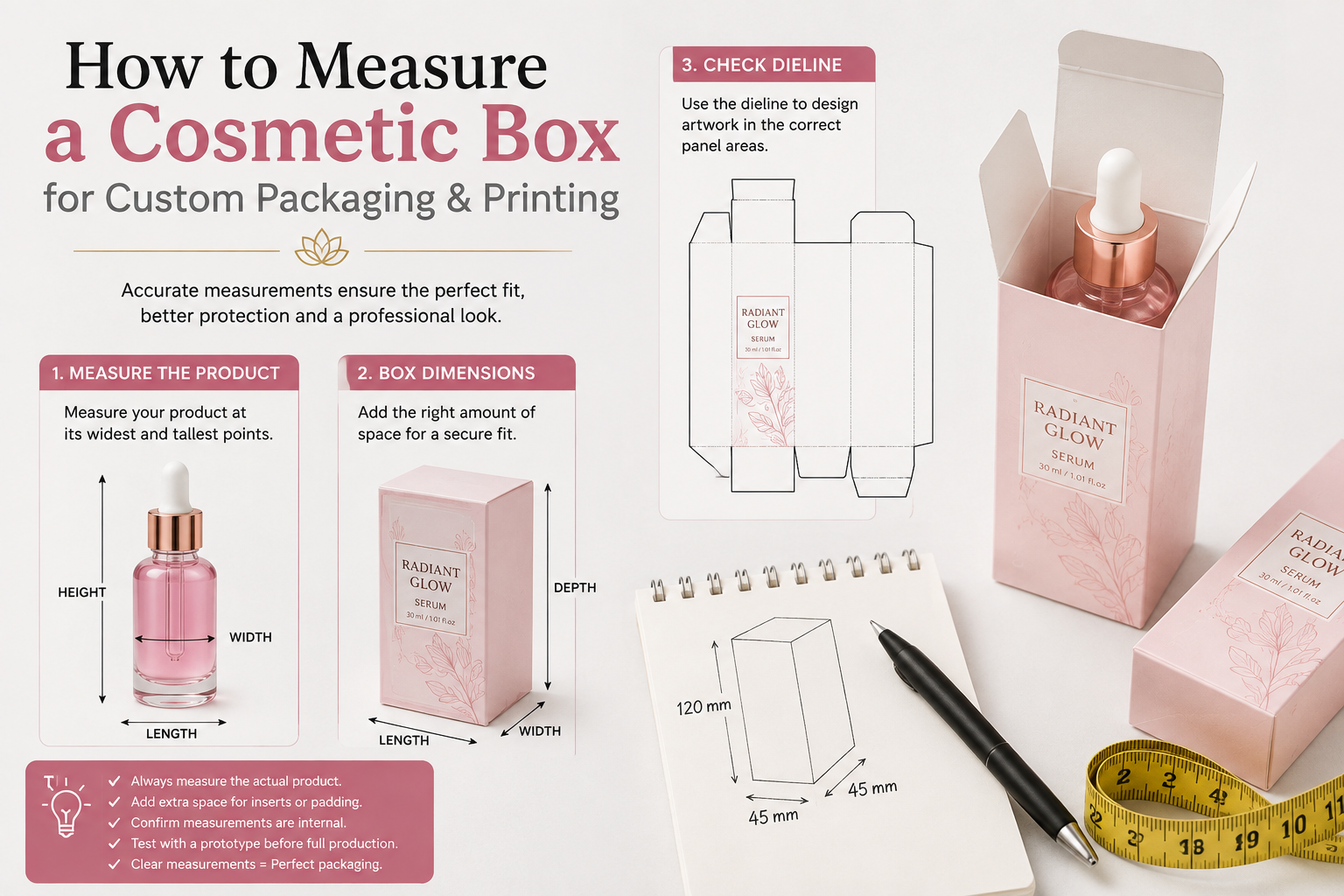
Measure the product at its widest and tallest points. Include caps, pumps, lids and any other part that extends beyond the main container.
For example, a serum bottle may have a narrow glass body but a wider dropper cap. Measuring just the bottle body could result in a carton that is too narrow at the top.
Write down all measurements in inches or millimeters and use the same unit throughout the project.
Consider the Primary Container
Cosmetics usually have primary and secondary packaging.
The bottle, tube, jar or compact that directly contains the cosmetic formula is the primary container. The paperboard carton surrounding it is secondary packaging.
Your custom box dimensions need to accommodate the complete primary container rather than just the amount of product inside.
A 30 ml serum does not automatically require the same carton as another 30 ml serum. Bottle shapes can be very different.
Understand Length Width and Depth
Measuring a Rectangular Cosmetic Box
Custom packaging dimensions are commonly communicated as length, width and depth. Your packaging supplier may use particular conventions, so confirm the measurement order before approving production.
For a basic rectangular folding carton, measure the three internal dimensions required to hold the product.
Length is commonly the longer horizontal dimension of the box opening.
Width is the shorter horizontal dimension.
Depth refers to the remaining dimension, which may represent box height depending on how the carton is positioned.
A cosmetic box measuring 5 inches by 2 inches by 1 inch is very different from one where those measurements have accidentally been entered in another order.
Internal and External Dimensions
This detail is easy to miss.
Internal dimensions describe the usable area inside the carton. External dimensions describe the outside of the completed package.
Paperboard has thickness. That means the outside measurements will be slightly larger than the usable interior measurements.
Tell the packaging manufacturer whether the dimensions you provide are internal or external. Assuming they already know can create a mistake that is discovered after production.
Allow Space for the Product
Do Not Make the Fit Too Tight
A cosmetic product should fit securely without being forced into its carton.
If a glass perfume bottle measures exactly 4 inches tall, making the usable interior exactly 4 inches can be risky. Production tolerances, folded panels and product variations can affect the actual fit.
A little clearance makes assembly easier.
Too much clearance creates another problem. The product can move around, making the package feel poorly sized and potentially increasing the chance of damage.
Test the Actual Product
Measurements on a specification sheet are useful, but a physical sample tells you more.
Place the real cosmetic container into a packaging prototype before ordering a large production run. Check how easily it enters and comes out.
Shake the prototype gently. If the bottle moves around excessively, the carton or insert may need adjustment.
This sounds basic, yet its one of the easiest ways to catch sizing problems early.
Measure Cosmetic Boxes With Inserts
Paperboard Inserts
Some cosmetic packaging uses inserts to hold the product in position.
An insert changes the usable space inside the box. You cannot simply measure the bottle and then order a carton with those exact dimensions.
The packaging designer needs room for the product, insert structure and carton walls.
Serums, fragrances and skin care sets commonly benefit from internal holders since glass containers can move during transportation.
Multiple Product Packaging
Gift sets and cosmetic kits require another level of measurement.
Measure every item individually first.
Then determine how the products will sit together inside the package. A skin care kit containing a cleanser, serum and moisturizer may place all three products next to one another or arrange them in separate sections.
Consider:
- Individual product dimensions
- Space between products
- Insert thickness
- Outer carton dimensions
- Opening direction
- Product removal space
- Required cushioning
Trying to calculate everything from the combined product widths can result in a really awkward fit.
Measuring Different Cosmetic Products
Lipstick and Mascara Boxes
Lipsticks and mascara tubes are usually narrow products, making measurement seem very simple.
Still, caps and decorative container shapes can make one section wider than another. Measure the widest point.
Long cosmetic cartons can bend if the paperboard is too light for the product weight, so dimensions and material selection needs to be considered together.
Serum and Essential Oil Bottles
Glass dropper bottles require careful measurement around the cap.
Measure bottle height from the bottom to the highest point of the closed dropper. Then measure the widest diameter.
If a paperboard insert holds the bottle, provide these measurements to the structural packaging designer.
Cosmetic Jars
Skin care jars can be short and wide.
Measure the diameter at the widest point and the total height with the lid fully attached.
Square jars need length and width measurements rather than diameter alone. Decorative lids may extend farther than the container body, so dont overlook them.
Makeup Palettes
Palettes are usually measured across their full closed dimensions.
Check length, width and thickness. If the palette includes raised decorations, closures or unusual edges, include those areas too.
The finished carton needs enough room for easy insertion without letting the palette slide excessively.
How Measurements Affect Custom Printing
Dieline Size
After the structural dimensions are finalized, the packaging manufacturer can prepare a dieline.
A dieline shows where the carton will be cut, folded and glued. Designers use it to position logos, product names, ingredients, instructions and graphics on the correct panels.
Do not create final artwork using guessed box dimensions.
Changing the carton size later can move panel boundaries and require artwork adjustments.
Safe Areas and Bleed
Printing that reaches the edge of a panel normally requires additional artwork outside the final trim area. Printers refer to this area as bleed.
Text and logos should remain within appropriate safe areas so cutting variation does not place important information too close to an edge.
Your printer should provide the correct specifications for its production process.
Create a Physical Prototype
A prototype is very useful before approving hundreds or thousands of custom cosmetic boxes.
Put the actual cosmetic product inside it.
Open and close the carton several times. Check whether flaps operate properly and whether the product can be removed without struggling.
Look at the printed panel positions too. A technically correct dieline can still produce a design that feels badly arranged once the box is assembled.
One prototype can reveal problems that are difficult to notice on a computer screen.
Common Cosmetic Box Measuring Mistakes
Small measurement errors can become expensive during production.
Common problems include measuring only the container body, forgetting the cap, confusing internal and external dimensions, switching measurement order and failing to account for inserts.
Another common mistake is rounding measurements too aggressively.
A bottle measuring 1.85 inches wide should not simply be treated as 2 inches without considering how that difference affects the complete package. Small changes multiply when thousands of cartons are manufactured and packed for shipping.
Measure twice and record everything clearly before requesting the dieline.
Final Measurement Checklist
Before approving your custom cosmetic packaging, verify the product dimensions, carton dimensions and artwork setup.
Make sure the actual container has been tested inside a sample whenever possible. Confirm which measurements are internal, check insert requirements and review the assembled prototype.
Custom packaging works much better when structural sizing comes before visual design. It may feel tempting to start with colors and graphics, but an attractive carton isnt useful when the product does not fit properly.
Frequently Asked Questions
How do you measure a cosmetic box?
Measure the usable length, width and depth of the carton. Confirm whether you are recording internal or external dimensions and follow the measurement order requested by your packaging supplier.
Should I measure the cosmetic product or existing box?
Measure the actual product first. This gives the packaging manufacturer the information needed to develop a carton around the container.
How much extra space should be inside a cosmetic box?
There is no single allowance suitable for every product. Material thickness, inserts, product shape and packing method affect the required clearance. A physical prototype can confirm the fit.
Do cosmetic box measurements include the cap?
Yes. Measure the complete closed product, including pumps, lids, droppers, caps and decorative components that affect its maximum dimensions.
What is a packaging dieline?
A dieline is a flat production template showing the cutting, folding and structural areas of a carton. Graphic artwork is positioned according to this template.
Should I print custom cosmetic boxes before testing the size?
A sample or prototype should be tested first when possible. This lets you check product fit, opening, inserts and artwork placement before committing to a larger production quantity.
Share It
Previous Post
Next Post
Recent Posts