Sunflower Drawing Through Art, Printing
Big Boxes for Safe Product Packaging
Arslan Khokhar
June 4, 2026
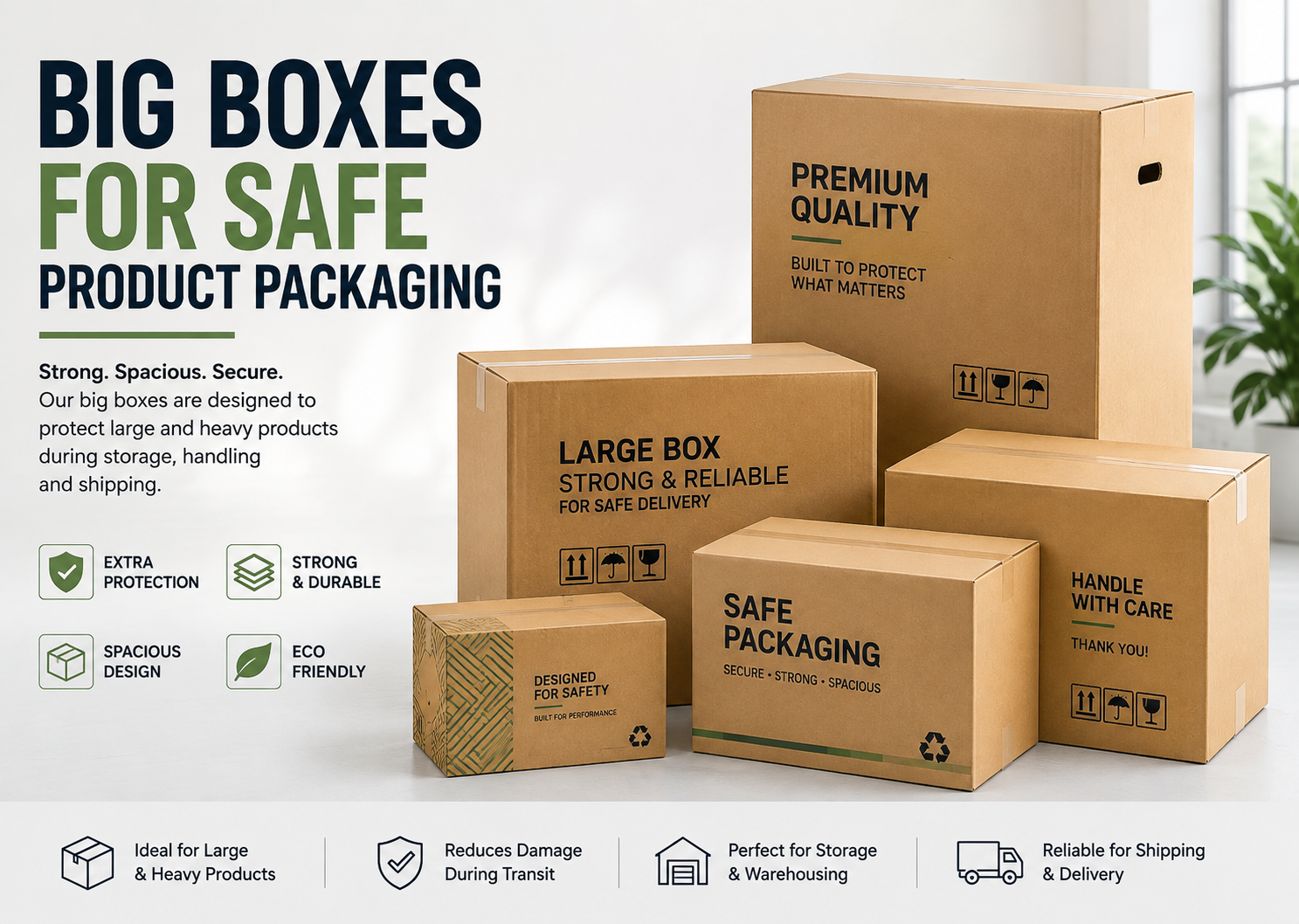
Large products create packaging problems that smaller cartons rarely face. More weight, greater dimensions and extra empty space can increase the chance of movement, crushed corners and product damage. Big boxes give manufacturers, ecommerce sellers, retailers and warehouses enough room to pack larger products with suitable protection and internal support.
Size alone does not make a large box suitable for shipping. Material strength, flute type, internal dimensions, product weight and closure method all matter. A box that is much larger than the item may actually create more problems since the product can shift during transportation.
What Are Big Packaging Boxes?
Large Boxes for Different Products
Big packaging boxes are cartons produced for products that cannot fit comfortably inside standard small or medium packages. They are commonly made from corrugated paperboard since its fluted construction gives the carton greater resistance against pressure.
These boxes can be used for home appliances, computer equipment, automotive components, lamps, toys, bulk retail goods, kitchen products and multiple smaller items packed together.
The dimensions should be based on the actual product plus the space needed for protective material. Ordering a very big box just because the product is large can result in excessive empty space.
Understanding Box Dimensions
Packaging dimensions are commonly listed as length, width and depth. Internal dimensions are particularly important since they represent the usable area inside the carton.
Measure the product at its widest points and account for handles, cables, attachments or unusual shapes. Protective inserts and cushioning need their own space too.
A manufacturer should create a sample before placing a large production order, especially for expensive or fragile products.
Why Large Products Need Strong Packaging
Weight and Pressure
Large products are often heavier, which places more pressure on the bottom panel and side walls of a carton. A material that performs well for a lightweight package may bend or tear when used for something much heavier.
Corrugated paperboard uses a fluted sheet between linerboards. The construction helps distribute pressure and provides cushioning against routine handling.
Single wall corrugated material may work for lighter goods. Double wall construction can provide more support for heavier products and demanding transportation conditions.
Product Movement
Empty space is a common packaging problem. When an item has room to move, it can repeatedly hit the interior walls during handling.
Cushioning, paperboard partitions and formed inserts can reduce this movement. Large fragile products may need support at several points rather than padding placed only around the sides.
Good internal support can be just as important as the outer carton itself.
Big Boxes for Shipping
Ecommerce and Delivery
Large ecommerce orders can travel through warehouses, sorting facilities, delivery trucks and customer doorsteps before reaching their final destination. Every stage introduces handling.
A shipping carton needs enough strength to handle stacking and normal transportation pressure. The bottom closure is very important for heavy goods since failure can cause the entire product to fall through the carton.
Heavy duty packaging tape can be applied using a suitable sealing pattern. Staples or other closure methods may be considered for certain industrial cartons.
Reducing Shipping Damage
A big shipping box should not automatically be filled with loose material. The goal is to hold the item in a stable position.
Useful protective materials include:
• Corrugated paperboard inserts
• Paper cushioning
• Molded pulp supports
• Paperboard corner guards
• Dividers for multiple products
• Protective sleeves
A combination of these materials may be required for products with irregular shapes.
Custom Big Boxes for Products
Custom Sizing
Custom dimensions can reduce unnecessary empty space. This may lower the amount of cushioning needed and create a package that is easier to handle.
For example, a large lamp with a narrow base and wide shade needs different internal support than a rectangular appliance. Using one generic carton for both products probably wont provide a good fit.
Custom box structures can be developed around the dimensions and weight distribution of the item.
Internal Inserts
Large packages often benefit from internal inserts. Inserts can hold products away from the exterior walls and protect vulnerable areas.
An electronic device may need support around its corners. A glass product may require separation from accessories packed inside the same carton. Multiple retail products can use dividers to stop surfaces rubbing together.
Paper based inserts can be folded into many shapes without taking excessive room.
Choosing Corrugated Paperboard
Single Wall and Double Wall Boxes
Single wall corrugated cartons contain one fluted layer. They are widely used for ordinary shipping applications where product weight and transportation conditions are moderate.
Double wall boxes contain additional liner and flute layers. They offer increased structural support and may be suitable for heavier goods, stacked shipments or products requiring more protection.
Material choice should be based on actual packaging requirements rather than box size alone.
Flute Selection
Corrugated flute profiles vary in thickness and performance. Some provide better cushioning, while others offer improved resistance to crushing or a smoother printing surface.
The correct flute depends on the package design, weight, printing requirements and distribution environment. A packaging supplier can perform compression and material tests before production.
Printing and Branding Large Boxes
Printed Shipping Cartons
A large carton provides plenty of printable surface. Companies can add logos, handling instructions, product information and recycling details.
Simple printing is often enough for shipping cartons. A logo, company name and handling information can identify the package without covering every panel with artwork.
Retail cartons may require more detailed graphics, particularly if the package will remain visible inside a store.
Handling Information
Useful information can include product orientation, quantity, storage requirements and relevant handling instructions.
Symbols and text should be printed where warehouse workers can actually see them. Printing an important instruction on the bottom panel does very little once several boxes are stacked.
Any safety or regulatory information required for a particular product should be checked before printing.
Storage and Warehouse Considerations
Stackability
Large boxes consume considerable warehouse space. Consistent dimensions can make pallet loading and storage more manageable.
Boxes should be stacked according to their weight and structural limits. Heavy cartons placed on weak packages can cause compression damage.
Humidity can affect paperboard performance too. Warehouses should store unused cartons and packed products away from excessive moisture where possible.
Pallet Planning
Many large shipments move on pallets. Box dimensions should work efficiently with the selected pallet size.
Poor sizing can leave cartons hanging over pallet edges, making them more vulnerable to impacts. Too much unused pallet space is inefficient as well.
Packaging dimensions and pallet configuration should ideally be considered together before large scale production begins.
Sustainable Choices for Big Packaging
Large cartons naturally use more material, so reducing unnecessary dimensions can make a meaningful difference.
Brands can consider recyclable corrugated paperboard, responsibly sourced fibers and paper based cushioning. Right sizing may reduce material use and shipping volume at the same time.
Excess packaging does not always mean better protection. A smaller properly designed carton with effective internal support can perform better than a huge box packed with unnecessary filler.
Frequently Asked Questions
What material is used for big shipping boxes?
Corrugated paperboard is commonly used for large shipping cartons. Single wall or double wall construction may be selected according to product weight and shipping requirements.
Are bigger boxes safer for large products?
Not necessarily. Excessive empty space allows products to move. A properly sized carton with suitable internal support usually provides better protection.
Can large boxes be custom printed?
Yes. Logos, handling instructions, product information, barcodes and other relevant details can be printed directly onto many corrugated boxes.
How should heavy products be packed?
Heavy items need a carton rated for their weight, secure bottom closure and internal supports that control movement. Packaging should be tested with the actual product before bulk production.
Can big boxes be recyclable?
Many corrugated paperboard cartons can enter paper recycling streams, depending on coatings, adhesives, contamination and local recycling requirements.
Share It
Previous Post
Recent Posts